3I/ATLAS: Latest Updates on the Interstellar Visitor Traversing Our Solar System

A Rare Visitor from Another Star System: Comet 3I/ATLAS
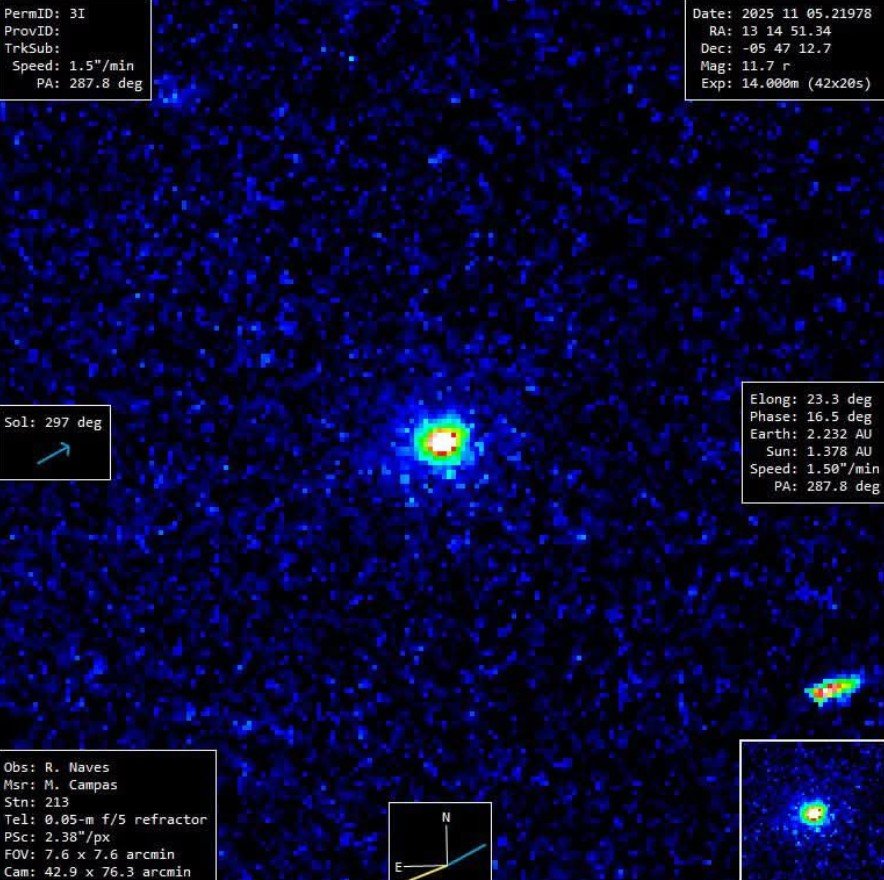
Back in 2025, something really caught the attention of astronomers and space fans all over the globe: a comet called 3I/ATLAS. The Asteroid Terrestrial-impact Last Alert System (ATLAS), located in Chile, spotted it on July 1st. What made this comet so special? It came from outside our Solar System. Scientists call these objects interstellar. This means it wasn’t born around our Sun. Instead, it traveled a long, long way from another star system. This marks only the third instance we’ve observed such an interstellar traveler, preceded by 1I/ʻOumuamua and 2I/Borisov.
What sets 3I/ATLAS apart isn’t only its origin. It’s a huge opportunity for learning. Think of it as a time capsule, giving us a peek at the stuff that makes up planets around other stars—planets we can’t reach directly. By studying this comet, we can get clues about what conditions are like when other planetary systems form, billions of miles away.
How We Found It and Where It Went
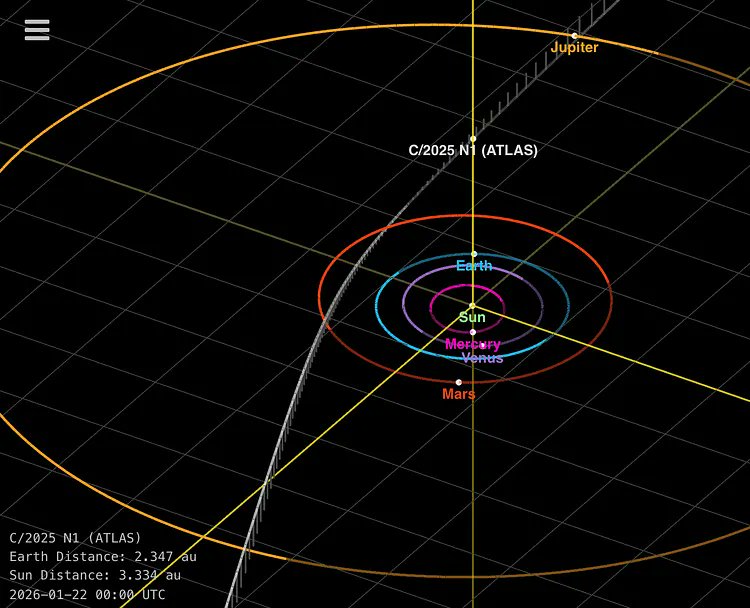
The ATLAS system has wide-field telescopes, perfect for scanning large areas of the sky. These telescopes are what first picked out 3I/ATLAS. It quickly stood out because of its path. Scientists calculated its orbit and realized it was a hyperbola, a curve that shows the object isn’t bound to the Sun by gravity. It was just passing through. The comet swung closest to the Sun on October 30, 2025, reaching about the same distance as Mars’ orbit. Then, it started heading back out into the vastness of space.
Telescopes on Earth kept a close eye on 3I/ATLAS. On December 19, 2025, it made its closest approach to our planet. This was a prime opportunity for astronomers to take measurements and learn as much as possible. The comet was moving extremely fast, clocking in at roughly 130,000 miles per hour. Keeping track of it wasn’t easy, but the chance to gather data from different wavelengths of light was too good to pass up.
Read also:
Greenland–US Conflict 2026: Sovereignty, Strategy, and Arctic Tensions Explained
Why 3I/ATLAS Matters to Science
Because 3I/ATLAS traveled to us from interstellar space, It’s an invaluable find. Its ingredients and how it acts tell us a lot about other star systems, maybe even ones incredibly far away. Based on preliminary info, 3I/ATLAS might be very old, maybe older than our own Sun. That would make it an amazing relic, a kind of living fossil from the early days of the universe.
The thing scientists want to know the most is what it’s made of. The comet seems to have water ice, carbon dioxide, dust, and other things that easily turn into gas. That hints that the raw ingredients for making planets are pretty similar from one star system to another. Getting a better handle on these elements might explain how planets and comets change as they float around between the stars.
The Big Guns: Hubble, JWST, and More
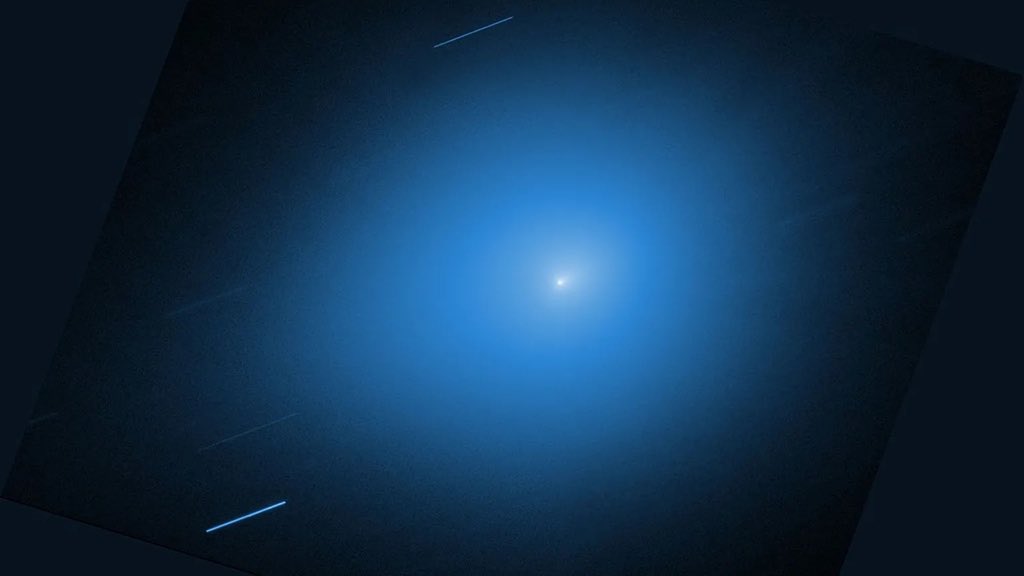
The Hubble Space Telescope got some clear pictures of 3I/ATLAS. They revealed a coma, a cloud of glowing gas and dust surrounding the comet’s core. A tail was developing, too, as the comet got closer to the Sun. While it looked like comets we’re used to seeing in our Solar System, there were differences. For example, the dust particles were scattered in a way that’s typical of interstellar objects.
The James Webb Space Telescope (JWST) was able to confirm some key details. It showed that 3I/ATLAS contained a lot of CO₂, water ice, and other chemicals that evaporate easily. The assumption is that the comet began in a cold, faraway spot before going on a long, possibly billions-of-years-long, trip through the galaxy.
Scientists didn’t stop there. They pointed other telescopes at 3I/ATLAS, too, including XMM-Newton, an ESA telescope that sees X-rays. This helped them observe the energetic interactions between the comet and the radiation coming from the Sun. This gives us a way to see how interstellar comets behave when they’re exposed to sunlight and cosmic rays, things they wouldn’t encounter out in deep space.
Read Also:
Introduction: Mahindra’s Big Move
Breaking Down the Light: Analysis of the Comet’s Composition
Spectroscopy is a process where scientists spread light out into a spectrum, like a rainbow. By studying this spectrum, they can figure out what chemicals produced that light. Telescopes like the Very Large Telescope (VLT) in Chile are perfect for this. They got high-resolution data that showed the chemical composition of the comet’s coma and tail in great detail. The data verified the presence of water ice, CO₂, and silicate dust, which checks out with the expectations for natural comets.
Based on recent studies, 3I/ATLAS could be over 14 billion years old, which is possibly older than the Solar System itself. This is a mind-blowing find for scientists, giving them a chance to examine material from the early universe that hasn’t changed much since then.
Looking for Alien Signals and Confirming It’s Natural
Since 3I/ATLAS was such an unusual object, a lot of people wondered if it could be artificial. Astronomers decided to look for technosignatures, signs of alien technology, using radio telescopes. They listened for any unusual signals, but they didn’t find anything. That pretty much verified that 3I/ATLAS is a comet like any other, just one that came from somewhere else.
The fact that it’s natural makes it even more helpful. It represents a sample of material from another star system that hasn’t been messed with. Its path, fast speed, and the stuff it’s made out of provide a baseline for analyzing any interstellar objects we see in the future.
Where Things Stand: Ongoing Observation and Global Excitement
In early 2026, 3I/ATLAS continued to be an item of interest all over the world:
NASA and Telescopes on Earth: NASA spacecraft and telescopes on the ground, like Gemini North and South, are still watching the comet. They are still capturing pictures of its greenish glow and tail.
Scientific Insights: Researchers are sifting through the data to figure out how interstellar objects manage to survive for so long in space. They’re also examining how the comet’s composition changes once it enters our Solar System.
Interest From the Public: Even amateur astronomers were able to spot the comet as it passed closest to the Sun. That sparked interest on social media, along with projects to educate the public about interstellar phenomena.
All this guarantees that 3I/ATLAS will stay a hot topic in astronomy, space, and outreach for quite a while.
The Difficulties Involved in Watching It
Trying to see 3I/ATLAS has been hard. It moves so fast and is so faint, plus it zips across the sky. It became harder to see as it traveled away from the Sun and Earth, so large telescopes and sensitive equipment were needed to keep track of it.
Whenever we discover other interstellar objects, we will remember what we learned from watching 3I/ATLAS in particular. This includes how to effectively track objects moving on hyperbolic paths, how to analyze their light, and how to coordinate observations between different groups around the world.
Why It Matters: To Science and to Us
3I/ATLAS is more than just a brief visitor. It’s a once-in-a-lifetime chance for scientists to:
- Study the chemistry and dust that exists between stars.
- Compare objects from another star system to the comets in our own Solar System.
- Fine-tune our math models for objects that travel on hyperbolic orbits and how things move around between the stars.
The discovery of this comet also highlights the need for continuous sky surveys, like the one done by ATLAS, and to promote teamwork.
In Conclusion: A Message From Deep Space
Comet 3I/ATLAS is a remarkable messenger from another star. It’s giving us insights into the raw material that forms other planetary systems. Its trip through our Solar System has expanded our understanding of space chemistry, comets, and how the galaxy evolves.
Even though 3I/ATLAS is now leaving the inner Solar System, the data collected will keep scientists busy for decades. They’re already getting ready for the next interstellar visitor, using what they learned from 3I/ATLAS to get better at spotting these objects, watching them, and analyzing them.
3I/ATLAS is an example that the universe is huge and always changing—full of surprises—and has countless wanderers from other places that are just passing through our small part of space.